Merger Under the Turkish Commercial Code: Concept, Procedure, and Breaking Points in Practice
31 Ekim 2025


Authors: Corporate Law Department, Atty. Mustafa Şahin
Introduction
Under the Turkish Commercial Code No. 6102 (“TCC”), a merger refers to the transfer, as a whole and without liquidation, of the assets of one or more companies to another company—either an existing company or a newly incorporated one—based on a contractual framework. In return, the shareholders of the transferred company automatically acquire shares and partnership rights in the acquiring company in accordance with a pre-determined exchange ratio, thereby becoming shareholders of the acquiring company. The transferred company is dissolved and struck off the trade registry (TCC Art. 136/3–4). This structure departs from the classical liquidation logic, emphasizing the universal succession (külli halefiyet) of assets and the uninterrupted continuation of shareholder status.
Article 136 of the TCC divides mergers into two types: merger by acquisition, where one company takes over another, and merger by formation of a new company. In practice, the former is more common due to efficiency and time advantages.
1. Compatibility and Cross-Type Mergers (Arts. 137–138)
The Code defines which types of companies may participate in a merger and their compatibility. In principle, there is no obstacle to mergers among capital companies. In cross-type mergers, a compatibility assessment is conducted by considering the debts and liabilities assumed by the acquiring company and the shareholding structure of its shareholders. At this point, factors such as the acquiring company’s minimum capital requirement, corporate organs, share regime, and liability status directly influence the technical design of the merger agreement.
2. Protection of Shareholders’ Shares and Rights (Arts. 140–141)
Shareholders of the transferred company have the right to demand equivalent shares and rights in the acquiring company. The equivalence is assessed considering the companies’ asset values, distribution of voting power, and other material parameters. Where a pure equality in the exchange ratio cannot be achieved, a cash adjustment (equalization payment) not exceeding one-tenth of the nominal deviation may be stipulated. Furthermore, the merger agreement may grant shareholders an option to receive a cash compensation (withdrawal payment) instead of shares or partnership rights. This option provides protection particularly for minority investors; however, the withdrawal payment must correspond to the fair value to minimize future annulment risks.
Determination of the Exchange Ratio: Methodological Framework
The TCC does not impose a specific valuation method. In practice, a weighted outcome is derived by jointly assessing the asset-based approach (net asset value), income-based approach (discounted cash flow, dividend discount), and market-based approach (comparable multiples, stock exchange values). Preferred shares, differences in voting power, undistributed profits, and hidden reserves are incorporated into the exchange ratio. A transparent methodological note and an independent third-party valuation report are of critical importance for both corporate governance and potential judicial review.
3. Capital Increase, Interim Balance Sheet, and Notification of Material Changes (Arts. 144, 150)
In a merger by acquisition, the acquiring company must increase its capital to a level sufficient to satisfy the rights of the transferring shareholders. If more than six months have passed between the date of the merger agreement and the last balance sheet date, or if significant changes have occurred in the assets after that date, an interim balance sheet must be prepared. A physical inventory is not mandatory; prior valuations, accounting records, depreciation and provisions, and value changes significantly affecting the enterprise shall be taken into account. If a material change arises in assets or liabilities during the agreement–general assembly period, the management body must notify the counterparties; if necessary, the agreement is amended or suspended; otherwise, the absence of change must be declared at the general assembly.
4. The Merger Agreement and Its Essential Elements (Arts. 145–146)
The merger agreement must be executed in writing and signed by the management bodies of the parties before being submitted to the general assembly for approval. It must at minimum include the trade name, type, and registered office of the parties, the exchange ratio and any equalization payment, rights of privileged or non-voting shares and usufruct certificates, the procedure for conversion, commencement date of profit entitlement, withdrawal payment, the date from which acts and transactions will be deemed on behalf of the acquiring company, special benefits granted to management bodies, and details on partners with unlimited liability. In non-public joint stock companies, the approval quorum is three-quarters of the votes present; if the merger entails an amendment to the business scope, the quorums applicable to articles of association amendments also apply.
Special Assembly of Privileged Shareholders
If the merger restricts or materially affects privileges, the approval of the special assembly of privileged shareholders under Article 454 of the TCC is required. Registration without such approval increases the risk of annulment actions; therefore, the special assembly process must be incorporated into the merger timetable from the outset.
5. Merger Report and SME Exemption (Art. 147)
The management bodies of the parties must prepare a reasoned merger report explaining the purpose and consequences of the merger, the main terms of the agreement, the exchange ratio and equalization, justification of the withdrawal payment, valuation method, possible capital increase, additional payment or personal performance obligations, effects of any conversion of company type, impact on employees and creditors, and necessary administrative approvals. In small and medium-sized enterprises, the report requirement may be waived by unanimous consent of all shareholders, reducing transaction costs; however, other public disclosure obligations (announcement and website publication) must continue so as not to impair information transparency.
Note on the Transaction Auditor
The previously mandatory institution of a transaction auditor has been abolished by legislative amendments. Nevertheless, in complex intra-group transactions, obtaining an independent expert report remains good practice in terms of management liability and litigation risk.
6. Right of Examination and Transparency
At least thirty days before the general assembly, the merger agreement, merger report, financial statements, and activity reports of the last three years (and, where applicable, the interim balance sheet) must be made available for inspection at the company’s head office and branches and published on its website. Announcements regarding the right of examination must be published in the Turkish Trade Registry Gazette (TTRG) and on the company’s website. Although SMEs may waive the right of examination by unanimous consent, this option should be evaluated carefully from an investor relations and dispute-management perspective.
7. Registration, Legal Effects, and Simplified Merger (Arts. 155–156)
A merger becomes effective upon registration with the trade registry; at the moment of registration, all assets and liabilities of the transferring company automatically pass to the acquiring company; the transferring company is dissolved and deleted from the registry. Under certain conditions, the simplified merger regime applies: where the acquiring company holds all voting shares of the transferring company, or where all voting shares of the merging capital companies are under common control, the agreement may contain only limited particulars; no merger report or right of examination is required; and general assembly approval may not be necessary. This regime enhances transactional efficiency in cases of full control.
8. Protection of Creditors and Employees (Arts. 157–158)
Creditors applying within three months following registration must be provided with security. The parties must issue three calls in the TTRG and online, at intervals of seven days. In lieu of security, payment of the debt is also possible; however, the security obligation arises only if the merger endangers satisfaction of the claim. The Court of Cassation emphasizes that the acquiring company is liable to provide security when the request is duly made and the danger proven.
Partners who were personally liable for the debts of the transferred company prior to the merger remain liable thereafter; a three-year limitation period applies from the date of the announcement. Employment relationships are transferred to the acquiring company pursuant to the principles of integrity of the workplace and employment contracts; employees’ vested rights are preserved, and any social plan must be disclosed in the merger report.
9. Merger Involving a Company in Liquidation
A company in liquidation may also participate in a merger, provided that its assets have not yet been converted into cash and no distribution to shareholders has been made. The stage of the liquidation process must be carefully managed together with the interim balance sheet and material change notification.
10. Judicial Review of General Assembly Resolutions
Merger resolutions may be challenged by annulment actions under the general provisions of the TCC. Grounds for annulment notably include procedural defects (deficiencies in reports, examination rights, or announcements), omission of the special assembly of privileged shareholders, clear breach of the equivalence principle, and abuse of minority rights. Time limits are short; after registration, only nullity or inexistence claims are examined in limited circumstances considering the balance of interests. A robust transaction file—comprising minutes, valuation studies, announcements, and notifications—is the most effective safeguard against annulment risks.
11. Competition Law Aspect (Law No. 4054)
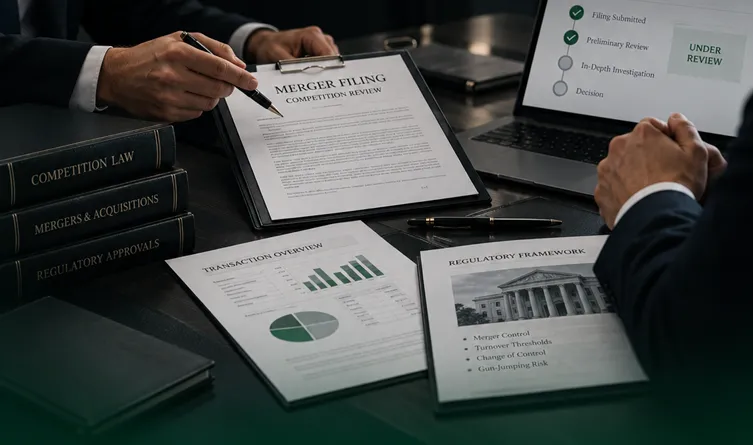
Compliance with the TCC does not eliminate the requirement of merger control under competition law. Mergers and acquisitions exceeding certain thresholds must be notified to the Competition Authority and are subject to approval. The notification requirement depends on the correct assessment of turnover and control relationships among the parties. In terms of timing, Competition Authority approval is generally inserted in the merger agreement as a closing condition.
Conclusion
A merger under the TCC is not a mere formal contract; it is a multi-layered process extending from valuation methodology to privilege management, from creditor calls to employee transfers, from interim balance sheets to material change notifications, and from special assemblies to potential annulment risks. A sound documentation architecture, a transparent examination period, a realistic and reasoned exchange ratio, recourse to independent expertise where necessary, and alignment with the competition law timetable enhance both registration security and post-transaction immunity from disputes. Such a well-structured merger regulates the transfer of value among shareholders fairly, safeguards the interests of creditors and employees, and ultimately ensures economic continuity through the transfer of assets without liquidation.
Stay Up-to-Date with Current Information