Material Transactions and Exit Right in Publicly Held Corporations
03 Temmuz 2026
Authors: Capital Markets Law Department, Atty. Mustafa Şahin
Introduction
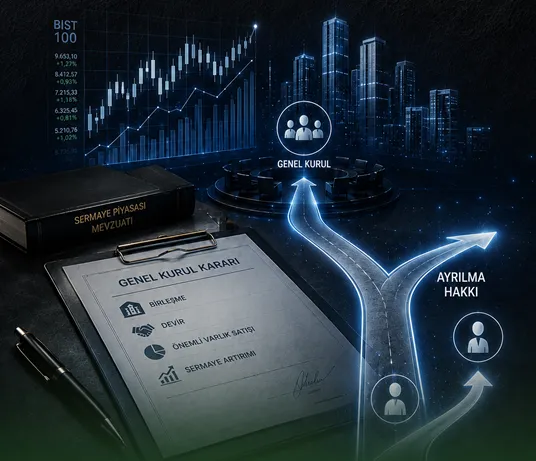
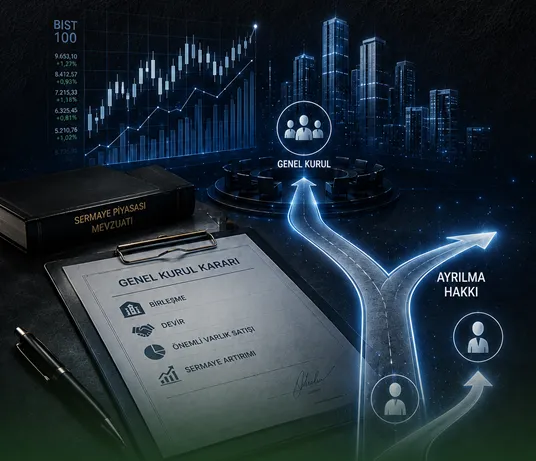
Certain transactions carried out by publicly held corporations cannot be regarded merely as commercial decisions relating to the company’s internal affairs. In particular, transactions that may materially affect the company’s asset structure, field of activity, capital structure, shareholding relations or investors’ investment decisions are subject to special procedural and protective mechanisms under capital markets law.
In this regard, the Capital Markets Board’s Communiqué No. II-23.3 on Material Transactions and Exit Right (“Communiqué”) regulates material transactions of publicly held corporations, the applicable materiality thresholds, board of directors and general assembly procedures, the principles governing the exercise of the exit right, the determination of the exit right exercise price, and the circumstances where the exit right does not arise or an exemption may be granted.
The main purpose of the Communiqué is to subject transactions that may materially affect investors’ decisions to a transparent decision-making and public disclosure regime, while granting shareholders who do not wish to participate in such transactions the opportunity to exit the company under certain conditions.
I. Concept of Material Transaction
Pursuant to Article 4 of the Communiqué, certain transactions are directly deemed to constitute material transactions. Accordingly, a company becoming a party to merger or demerger transactions defined under Article 5 of the Communiqué, changing its legal type, carrying out asset transfers or transactions resulting in asset transfers that meet the applicable materiality thresholds, establishing limited rights in rem over its assets in favour of third parties, creating privileges or changing the scope or subject matter of existing privileges are considered material transactions.
However, Article 4 of the Communiqué does not establish a system limited only to the transactions expressly listed therein. Under the same provision, the Capital Markets Board may also consider transactions that are not expressly listed in the Communiqué as material transactions if, when assessed as a whole, they may cause a substantial change in the company’s principal activities or ordinary course of business and may affect investors’ investment decisions.
Therefore, when assessing whether a transaction qualifies as a material transaction, not only the legal name or contractual structure of the transaction, but also its economic, financial and corporate impact on the company should be taken into account. For instance, an asset transfer may appear to be a simple sale transaction; however, if the relevant asset is critical for the conduct of the company’s principal activities or materially changes the company’s revenue structure, the transaction may require further assessment under the Communiqué.
II. Assessment of Mergers and Demergers as Material Transactions
Article 5 of the Communiqué introduces a specific regime for merger and demerger transactions. Accordingly, a company’s participation in a merger by way of incorporation of a new company, its position as the disappearing company in a merger by acquisition, or its position as the acquiring company where the merger will result in a capital increase of 50% or more are deemed to constitute material transactions.
A similar approach is adopted for demerger transactions. In full demergers, the company being the demerged company, or being the acquiring company and increasing its capital by 50% or more in consideration of the transferred assets, is considered a material transaction. In partial demergers, the transaction is considered material for the demerged company if the transferred assets meet the materiality thresholds under Article 6 of the Communiqué; for the acquiring company, the decisive criterion is whether the assets acquired in the demerger will result in a capital increase of 50% or more.
This framework aims to ensure that mergers and demergers, due to their potential impact on the structure of a publicly held corporation, are not only disclosed to shareholders but are also subject to general assembly approval and, where applicable, the exit right mechanism.
III. Materiality Threshold
Article 6 of the Communiqué regulates the materiality threshold, particularly for asset transfers and transactions resulting in asset transfers. The materiality assessment is made as of the date of the board of directors’ resolution.
Pursuant to Article 6 of the Communiqué, a transaction is deemed material if the ratio of the book value of the asset subject to the transaction to the total assets of the company, the ratio of the transaction amount to the company value, or the ratio of the income generated from the asset subject to the transaction to the relevant income items exceeds 75%.
However, the Communiqué does not provide a uniform assessment method for all companies. Special rules apply to real estate investment companies and venture capital investment companies in determining the materiality threshold. In addition, pursuant to Article 6 of the Communiqué, for listed companies that are not included in the First and Second Groups under the Corporate Governance Communiqué, and are not real estate investment companies or venture capital investment companies, where their free float ratio exceeds 50%, the applicable threshold is 50% instead of 75%.
One of the significant rules under Article 6 of the Communiqué concerns transactions structured in separate parts. If transactions relating to assets forming an economic whole are carried out in several stages within a twelve-month period from the date of the first transaction in order to remain below the thresholds set out in the Communiqué, such transactions are considered as a single transaction. This provision serves as an important safeguard against transaction structures designed to circumvent the material transaction regime.
IV. Board of Directors’ Resolution
Pursuant to Article 7 of the Communiqué, in order for a material transaction to be carried out, a board of directors’ resolution determining the main terms of the transaction must be adopted and the transaction must be approved by the general assembly. A general assembly resolution granting prior general authority to the board of directors does not eliminate the requirement for a specific general assembly approval under the Communiqué.
The required content of the board of directors’ resolution is set out in detail under Article 8 of the Communiqué. Accordingly, the board resolution must include the nature of the material transaction, the assessments made under the Communiqué, the rationale for the transaction, the exit right exercise price, the shareholders entitled to exercise the exit right and the conditions applicable to such exercise, and, if any, the summary or conclusion of valuation or similar reports forming the basis of the transaction.
In addition, if an application will be made to the Capital Markets Board for an exemption from the obligation to grant the exit right, the board resolution must include information on the relevant provision of the Communiqué on which the exemption application is based.
Pursuant to Article 8 of the Communiqué, the board resolution must be publicly disclosed together with information on whether independent board members voted and, if any, the dissenting opinions of such members. For companies whose shares are traded on the stock exchange, the relevant material event disclosure must be made outside the trading hours of the equity market.
V. General Assembly Agenda and Approval
Article 9 of the Communiqué contains specific rules regarding the agenda of the general assembly meeting at which the material transaction will be discussed. Accordingly, the agenda must include a separate item for the approval of the transaction, setting out the nature of the transaction and, where applicable, its amount, parties and other essential terms.
If the board of directors has resolved that the transaction may be abandoned upon the occurrence of certain conditions, the abandonment of the transaction and the relevant conditions must also be submitted to the approval of the general assembly as a separate agenda item. In addition, shareholders must be informed that the details regarding the exercise of the exit right are included in the information document.
Pursuant to Article 10 of the Communiqué, material transactions must be submitted to the approval of the general assembly to be convened within three months from the later of the date of the board of directors’ resolution and the date of any required permission or approval from the relevant authorities, including the Capital Markets Board.
The Communiqué provides a special quorum regime for publicly held corporations. Unless higher quorums are expressly stipulated in the articles of association, the affirmative votes of two-thirds of the shares with voting rights represented at the general assembly are required, without seeking a meeting quorum. However, if at least half of the shares representing the share capital with voting rights are present at the meeting, unless higher quorums are provided in the articles of association, the resolution may be adopted by the majority of the shares with voting rights represented at the meeting.
Article 10 of the Communiqué also includes a special rule on the exercise of voting rights. Accordingly, ultimate controlling real person shareholders who are parties to the material transaction within the scope of Article 436/1 of the Turkish Commercial Code, or companies controlled by such persons, may not vote at the relevant general assembly meeting if the transaction directly produces personal consequences for such real persons.
VI. Legal Nature of the Exit Right
Pursuant to Article 11 of the Communiqué, the exit right is a special capital markets law right that allows certain shareholders to exit the company by selling their shares to the company. This right is based on the principle that a shareholder who does not wish to participate in a material transaction should not be forced to remain invested in a company whose structure has materially changed.
As a rule, in order to exercise the exit right, the shareholder must attend the general assembly meeting at which the material transaction is discussed, vote against the relevant agenda item, and have their dissent recorded in the meeting minutes.
For companies whose shares are traded on the stock exchange, pursuant to Article 11 of the Communiqué, the date on which the board of directors’ resolution is publicly disclosed is taken as the basis for determining the shareholders entitled to exercise the exit right. If any public disclosure regarding the material transaction has been made by the company or its authorised representatives before the board resolution is disclosed, the date of such prior disclosure is taken into account.
For companies whose shares are not traded on the stock exchange, the date of the general assembly meeting at which the material transaction is discussed is taken as the basis for determining the shareholders entitled to exercise the exit right.
Article 11 of the Communiqué also provides that where a shareholder or their representative is unlawfully prevented from attending the general assembly meeting or exercising voting rights, or where the meeting call is not duly made or the agenda is not properly announced, the conditions of voting against the resolution and having the dissent recorded in the minutes are not required for the exercise of the exit right.
VII. Procedure for Exercising the Exit Right
Pursuant to Article 12 of the Communiqué, the exit right must be exercised through an intermediary institution. For companies whose shares are not traded on the stock exchange, the Capital Markets Board may, upon request, grant an exemption from the obligation to use an intermediary institution.
The exercise period for the exit right must commence no later than six business days following the date of the general assembly meeting. The exercise period is ten business days from the commencement date.
Shareholders who wish to exercise the exit right complete the sale by delivering the shares subject to the exit right to the intermediary institution designated by the company. Pursuant to Article 12 of the Communiqué, the share price must, as a rule, be paid by the company to the shareholders exercising the exit right no later than the business day following the sale.
For companies whose shares are traded on the stock exchange, shareholders wishing to exercise the exit right must exercise such right for all of their shares that are eligible for the exit right and have an active trading line on the stock exchange. This rule prevents shareholders from exercising the exit right only for part of their shares while retaining the remainder in the company.
VIII. Offering the Shares Subject to the Exit Right to Other Shareholders or Investors
Article 13 of the Communiqué allows companies whose shares are traded on the stock exchange to offer the shares subject to the exit right to other shareholders or investors before such shares are purchased by the company.
The application of this method requires a board of directors’ resolution. Shareholders or investors wishing to purchase the shares subject to the exit right must submit their written purchase requests to the intermediary institution designated by the company within three business days following the general assembly date and block the funds corresponding to the purchase amount with such intermediary institution.
Pursuant to Article 13 of the Communiqué, shares subject to the exit right are allocated among the requesting shareholders or investors on a pro rata basis, without creating inequality among them. However, if the requesting shareholders or investors agree on a different allocation method among themselves, such agreement may be taken as the basis. Shares that are not requested by other shareholders or investors are purchased by the company.
This mechanism provides an important opportunity to reduce the cash outflow that the company may otherwise face due to the exercise of the exit right.
IX. Exit Right Exercise Price
The exit right exercise price is regulated under Article 14 of the Communiqué. For companies whose shares are traded on the stock exchange, the exit right exercise price is calculated as the arithmetic average of the daily adjusted weighted average prices formed on the stock exchange during the last one-month period preceding the relevant date for companies whose shares are traded on the Star Market, and during the last six-month period for other companies.
For companies whose shares are not traded on the stock exchange, a valuation report must be prepared in order to determine the exit right exercise price. This report must be based on the value of the company as of the date on which the board of directors’ resolution adopted pursuant to Article 8 of the Communiqué is publicly disclosed.
Pursuant to Article 14 of the Communiqué, if a material change affecting the value of the company occurs between the date of the valuation report and the date on which the material transaction is discussed at the general assembly, an additional report showing the effect of such change on the exit right exercise price must be prepared and submitted to the general assembly. If the additional report concludes that the exit right price is affected, the exit right must be exercised over the newly determined price.
The exit right price must be paid in full and in cash. This rule aims to ensure that the exit right is not merely a theoretical protection mechanism, but one that enables the shareholder to effectively exit the company by receiving the economic value of their shares.
X. Circumstances Where the Exit Right Does Not Arise
Article 15 of the Communiqué sets out certain material transactions where the exit right is deemed not to arise. These include, among others, transactions that are mandatory under applicable legislation, transactions carried out by companies controlled by a public institution, mergers and demergers carried out through the simplified procedure, transactions carried out within the scope of liquidation, certain financing transactions, certain transactions carried out with subsidiaries in which the company owns at least 90% of the share capital, and the sale of subsidiary shares through a public offering.
Pursuant to Article 15 of the Communiqué, in cases where the exit right does not arise, unless a general assembly meeting is required under other applicable regulations, the adoption of a board of directors’ resolution is sufficient and no separate general assembly meeting is required. However, the board resolution containing the material transaction and the reason why the exit right does not arise must be publicly disclosed.
XI. Exemption from the Obligation to Grant the Exit Right
Article 16 of the Communiqué regulates the circumstances where an exemption from the obligation to grant the exit right may be granted. Accordingly, an exemption may be available in cases such as a voluntary tender offer specific to the material transaction being approved by the Capital Markets Board, the removal of privileges without consideration or the narrowing of their subject matter or scope, the company carrying out a material transaction for the purpose of overcoming financial distress, certain transactions involving the establishment of limited rights in rem, and certain intra-group transactions listed under the Communiqué.
Timing is crucial for exemption applications. Pursuant to Article 16 of the Communiqué, exemption applications must be made to the Capital Markets Board within ten business days following the date of the board of directors’ resolution. If, following its review, the Capital Markets Board concludes that the exemption conditions are satisfied, it may grant an exemption from the obligation to grant the exit right.
In particular, for exemption applications based on financial distress, an independent assurance report must be submitted to the Capital Markets Board, demonstrating that the company is in financial distress and that the material transaction may have positive effects in overcoming such distress.
XII. Liability and Practical Considerations
Pursuant to Article 18 of the Communiqué, the members of the board of directors of the company are responsible for compliance with the procedures and principles set out in the Communiqué. Therefore, the material transaction process should not be treated merely as a transaction timetable or general assembly preparation, but rather as a comprehensive compliance process covering the board resolution, public disclosures, general assembly agenda and exit right price.
In practice, the first step should be to assess whether the relevant transaction qualifies as a material transaction under Articles 4, 5 and 6 of the Communiqué. In making this assessment, the transaction amount, book value of the asset, income effect, company value, transactions at the subsidiary level, consolidated financial statements and previous transactions relating to the same economic whole should be considered together.
Secondly, the board of directors’ resolution should be prepared in accordance with Article 8 of the Communiqué. The resolution should include the rationale for the transaction, the assessment made under the Communiqué, the exit right exercise price and the explanations regarding the shareholders entitled to exercise the exit right.
Thirdly, the general assembly agenda and information document should be prepared in accordance with Article 9 of the Communiqué. The procedure for exercising the exit right, the exercise period, the exercise price, the method for offering the shares to other investors, if applicable, and the conditions for abandoning the transaction should be presented to shareholders in a clear and understandable manner.
Finally, the financial impact of the exit right on the company should be calculated before the transaction. Extensive exercise of the exit right may result in a significant cash outflow for the company. Therefore, depending on the nature of the transaction, the company may consider including an abandonment condition under Article 8 of the Communiqué or applying the mechanism under Article 13 of the Communiqué to offer the shares subject to the exit right to other shareholders or investors.
Conclusion
The regime governing material transactions and the exit right is one of the fundamental capital markets law mechanisms that balances the protection of investors in publicly held corporations with the company’s freedom to carry out significant corporate transactions.
The Communiqué subjects transactions that may affect the company’s operational structure, assets, privileges, merger and demerger processes, and the position of investors within the company to special decision-making and public disclosure rules. At the same time, it grants shareholders who do not wish to participate in such transactions the right to sell their shares to the company and exit under certain conditions.
Therefore, for publicly held corporations, material transactions should be assessed not only from the perspective of commercial benefit or transaction economics, but also in terms of compliance with the Communiqué, shareholder rights, public disclosure obligations, exit right costs and transaction security. Proper structuring of the process from the outset is crucial for the validity of the transaction and for the management of legal risks that may arise for both the company and its investors.
Stay Up-to-Date with Current Information